
Short answer: A commercial solar system in South Africa typically costs between R400,000 and R2,500,000+ in 2026, depending on size.
As a rule of thumb, expect to pay roughly R12,000 to R18,000 per kW installed — with the cost per kW dropping as the system gets bigger. Battery storage is the single biggest factor that pushes the price up.
That’s the headline.
But a solar system isn’t an off-the-shelf product with one price tag… two quotes for the “same” system can differ by 30% to 50%. This guide breaks down exactly what you’re paying for, what drives the cost up or down, and how to compare quotes properly so you know you’re getting a fair deal.
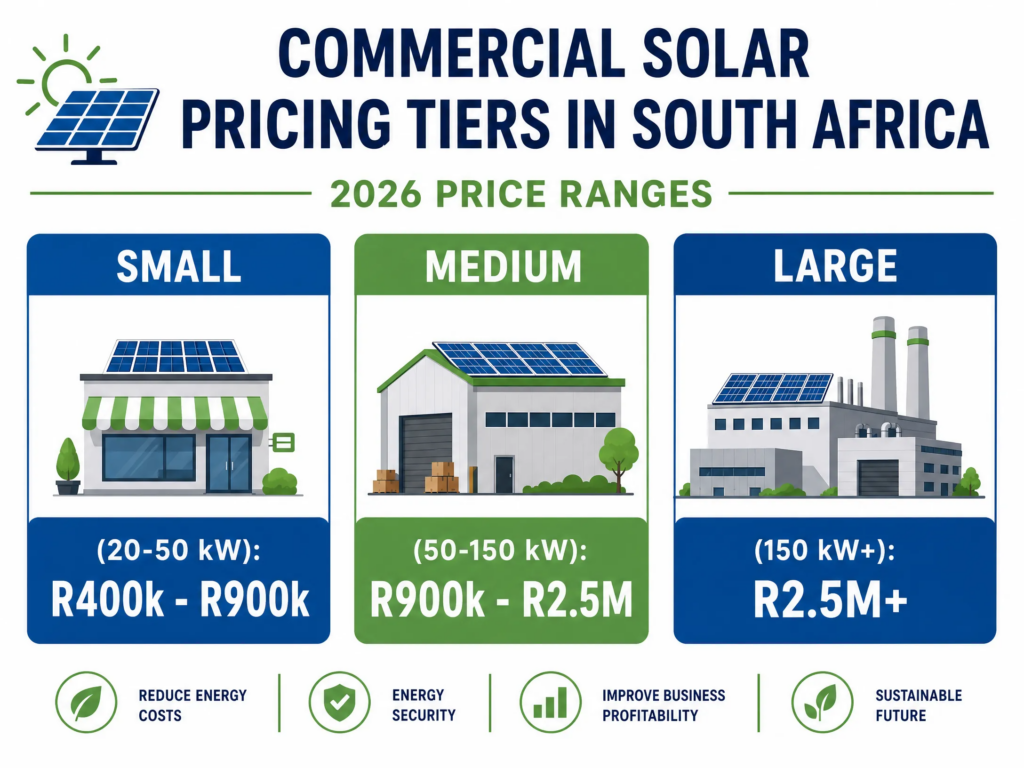
Here are realistic 2026 price ranges for commercial installations in South Africa:
Small (20–50 kW)
Offices, retail shops, workshops
R400,000 – R900,000
Medium (50–150 kW)
Warehouses, guesthouses, mid-size manufacturers
R900,000 – R2,500,000
Large (150 kW+)
Factories, cold storage, large commercial sites
R2,500,000 and above
These figures are for fully installed systems, not just the hardware.
Where your project lands within (or beyond) these ranges depends mostly on whether you need batteries, your roof or site conditions, and the quality of components you choose.
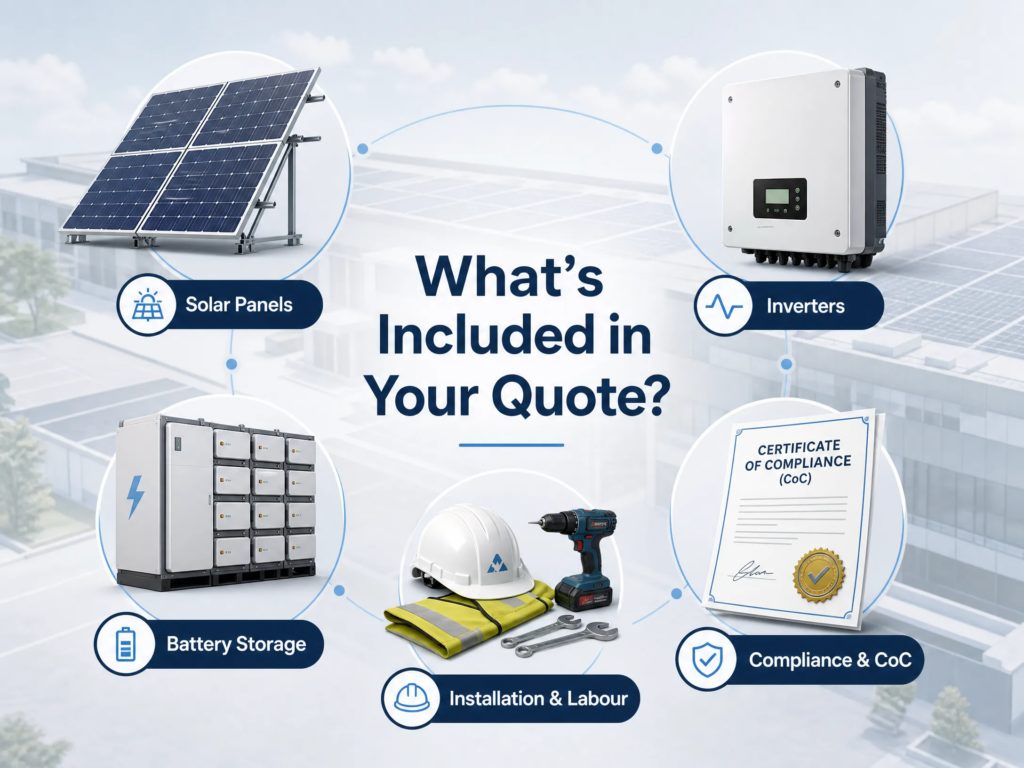
When you get a commercial solar quote, you’re paying for a complete, engineered system — not a box of panels.
A proper installed price includes:
A trustworthy quote separates these out on an itemised line-item basis.
If a quote is a single “all-inclusive” number with no breakdown, that’s a red flag, you can’t compare it fairly or see where corners might be cut.
The cleanest way to compare commercial solar quotes is cost per kW installed (sometimes shown as cost per Wp, or watt-peak). You simply divide the total system price by the system’s kW rating.
This matters because a bigger headline price isn’t necessarily a worse deal.
In fact, the cost per kW falls as systems get larger:
This is why undersizing to save money upfront often costs you more in the long run. A slightly larger system usually delivers a better cost per kW and more lifetime savings.
When you compare quotes, normalise them to cost per kW and you’ll quickly see which is genuinely competitive.
If you collect a few quotes, you’ll notice the prices vary… sometimes dramatically.
Here’s what’s behind that:
The system price is the bulk of it, but a few additional costs catch businesses off guard:
The good news: a reputable turnkey installer folds compliance, registration and commissioning into the quote, so there are no surprises later.
Here’s something many business owners miss: the sticker price isn’t your true cost.
Under Section 12B of the Income Tax Act, a business can deduct 100% of the cost of a qualifying solar PV system (up to 1 MW) in the first year. For a company paying tax at 27%, that deduction meaningfully reduces the effective cost of the system in year one.
VAT-registered businesses can usually also reclaim the input VAT on the purchase and installation.
So a system with a R1,000,000 price tag can have a substantially lower effective cost once the tax benefit is applied.
(Note: the enhanced 125% allowance under Section 12BA expired on 28 February 2025 — the current benefit is the still-valuable 100% deduction. Always confirm the specifics with a registered tax practitioner.)
Cost only means something next to savings.
With Eskom tariffs above R3 per kWh and rising 12% to 15% a year, a well-designed commercial system generates power at a fraction of grid cost… often around R1 per kWh once you account for the system’s lifespan.
For most businesses, that translates to a payback period of three to seven years, after which the power is essentially free for the remaining 15 to 20 years of the system’s life.
A business with high daytime electricity use can see even faster payback. (We cover the savings maths in detail in our guide on whether solar is worth it for your business.)
In other words: the cost is real, but for most commercial sites it’s an investment that pays itself back and then keeps paying.
Every business has a different roof, load profile, tariff and budget… so the only way to get a real number is a proper assessment of your site.
The starting point is always an energy audit: understanding how many units (kWh) you use, and crucially when you use them, so the system is sized correctly rather than over- or under-built.
A few tips to get a fair, accurate price:
At Allsolar, we start with an energy audit and design a system around your actual usage, with a transparent, itemised turnkey quote — covering design, supply, installation, integration and ongoing maintenance.
Because our designs are modular and expandable, you don’t have to fund everything at once: you can start with the system that covers your priority loads and scale up as your budget allows, which is one of the most practical ways to manage the upfront cost.
We’ve been in renewable energy since 2012, with more than 30 branches across Southern Africa, and every installation meets the relevant South African safety and grid standards.
How much does a commercial solar system cost in South Africa? In 2026, expect roughly R400,000–R900,000 for a small system (20–50 kW), R900,000–R2,500,000 for a medium system (50–150 kW), and R2,500,000+ for large installations. Installed costs work out to around R12,000–R18,000 per kW, with the per-kW cost falling as the system gets bigger.
What is the cost per kW of commercial solar? Commercial solar costs roughly R12,000 to R18,000 per kW installed in 2026. Smaller systems sit at the higher end; larger systems benefit from economies of scale and come down toward R12,000–R15,000 per kW or lower.
Why are some solar quotes so much cheaper than others? Price differences usually come down to battery storage, component quality (Tier 1 versus budget panels and inverters), roof or site complexity, and whether compliance and certification are included. Always compare itemised quotes on a cost-per-kW basis rather than the headline figure.
What’s the biggest cost in a commercial solar system? For systems with storage, the battery bank is usually the most expensive single component. A grid-tied system without batteries is significantly cheaper, so the right design depends on whether your business needs power after dark.
Does the price include installation and compliance? A proper turnkey quote includes installation labour, commissioning, a Certificate of Compliance (CoC) and grid registration. Be wary of hardware-only prices that exclude these essential — and legally required — components.
Can I reduce the cost with tax incentives? Yes. Section 12B allows a business to deduct 100% of a qualifying solar PV system’s cost (up to 1 MW) in the first year, and VAT-registered businesses can usually reclaim input VAT — lowering the effective cost considerably. Confirm specifics with a registered tax practitioner.
The ranges in this guide are realistic 2026 averages — but your actual cost depends on your premises, your energy use and the system that’s right for you.
Allsolar provides energy audits and transparent, itemised turnkey commercial solar quotes — from system design and supply through to installation, integration and maintenance — backed by a nationwide network of more than 30 branches.
If you’d like a clear, no-obligation cost estimate tailored to your site, contact your nearest Allsolar branch or request a quotation.
This article is intended as general information and reflects the South African solar market as of mid-2026. Costs, tariffs and tax rules change over time. For tax matters, please consult a registered tax practitioner.
2025 ALLSOLAR.ALL RIGHTS RESERVED
Scroll Up