
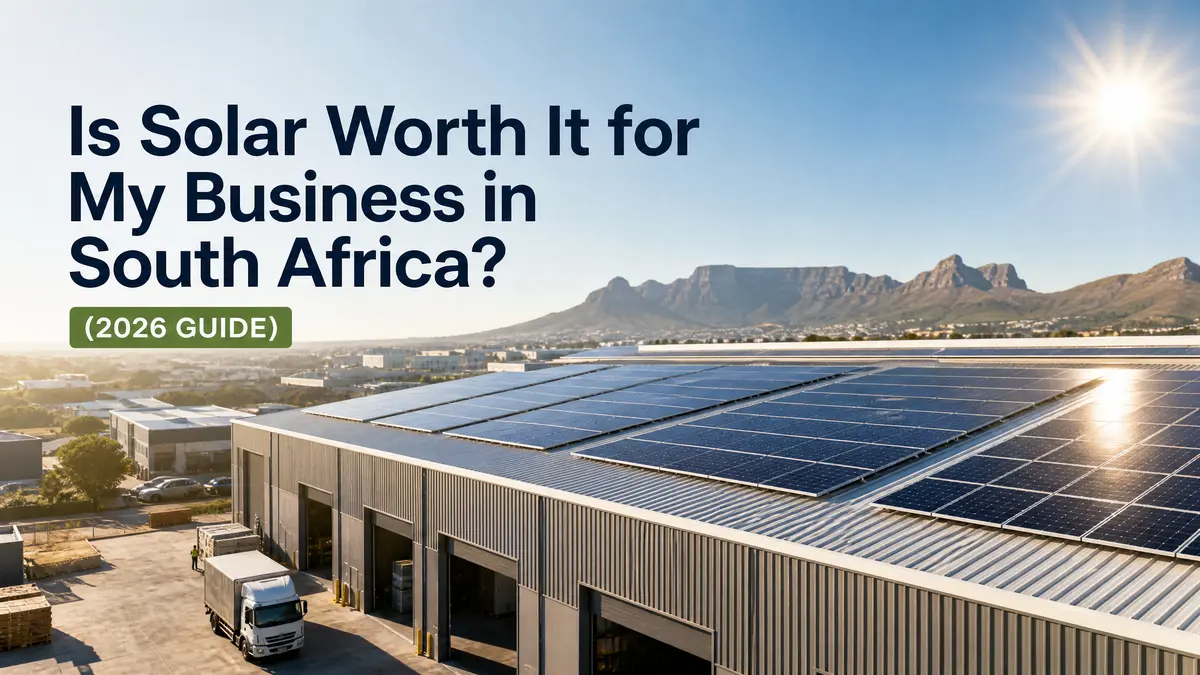
Short answer: Yes!
For most South African businesses, commercial solar is still a sound investment in 2026.
But the reason has changed.
With load shedding largely behind us, the case for going solar is no longer about keeping the lights on during blackouts. It’s now about protecting your business from relentless electricity price increases, claiming significant tax deductions, and locking in a lower cost of power for the next 20 to 25 years.
Whether it’s worth it for your specific business depends on how much electricity you use during daylight hours, your roof or ground space, and your current tariff. This guide walks through the real numbers so you can make an informed decision.
This is the question on every business owner’s mind in 2026, and it’s a fair one.
South Africa passed 300 consecutive days without load shedding in March 2026, and the government has effectively declared the energy crisis over. So if the grid is stable, why spend money on solar?
Because the backup argument and the savings argument are two very different things.
Load shedding was always the dramatic, visible problem. The quieter, more permanent problem is the cost of grid electricity, which continues to climb at roughly 12% to 15% per year.
Eskom tariffs now sit above R3.50 per kWh for many users, and further increases have already been approved for the 2026, 2027 and 2028 financial years.
For a business, that’s a cost line that only ever goes up — and one you have almost no control over.
Solar changes that. Once your system is paid off, the power it produces is effectively free for the remaining 15 to 20 years of its life.
You’re swapping an unpredictable, ever-rising expense for a fixed, known one. That’s the real reason commercial solar still makes sense, even in a country that has put the worst of its blackouts behind it.
The simple way to think about it: Load shedding made solar urgent. Rising tariffs make it smart.
Commercial solar pricing varies widely depending on system size, whether you include battery storage, your roof structure, and grid-connection requirements.
As a general guide for South African businesses in 2026:
Small (20–50 kW)
Small offices, retail shops, workshops
R400,000 – R900,000
Medium (50–150 kW)
Warehouses, guesthouses, mid-size manufacturers
R900,000 – R2,500,000
Large (150 kW+)
Factories, cold storage, large commercial sites
R2,500,000 and above
These ranges typically include panels, inverters, mounting structures, cabling and, where required, a battery bank. The single biggest cost variable is usually battery storage.
A grid-tied system with no batteries is considerably cheaper than a hybrid system designed to run through the night, so the right design comes down to when your business actually uses power.
A useful detail many business owners miss: the cost per kW drops as systems get bigger. Oversizing slightly for future growth is often more economical than undersizing to save on the initial outlay.
These are indicative 2026 market figures. The only way to get an accurate price is a proper energy audit of your specific site, which is where we’d usually start.
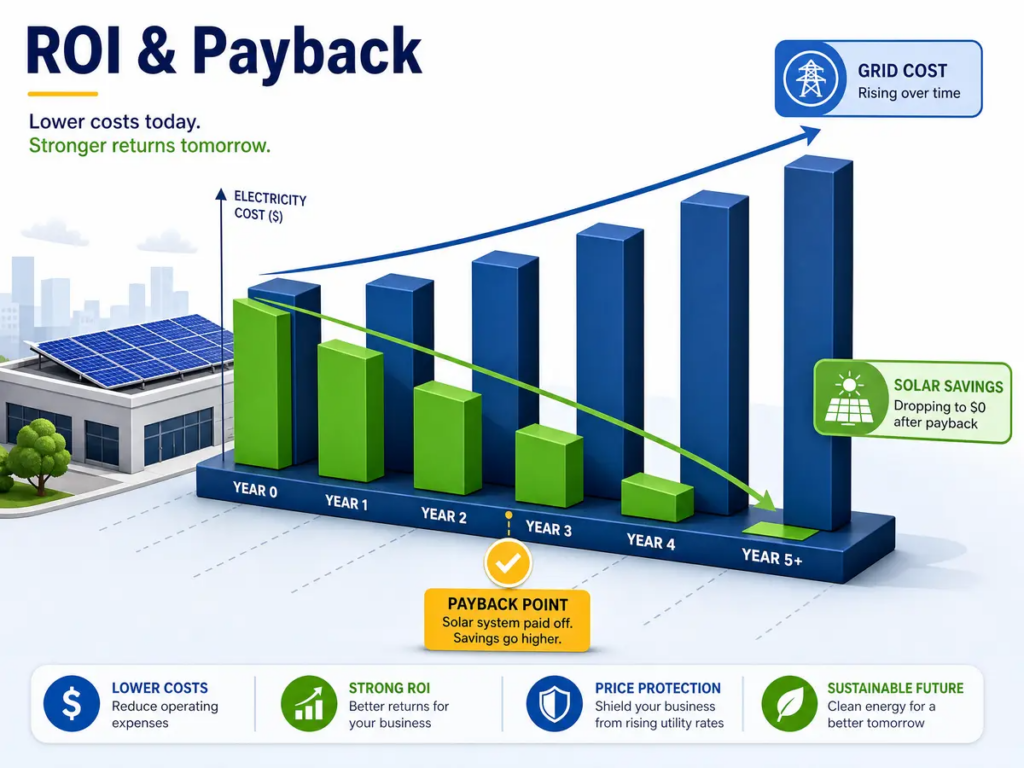
For most South African businesses, commercial solar pays for itself within three to seven years, then continues generating power for another 15 to 20 years after that.
The exact payback depends on how much you currently spend on electricity and how much of your usage solar can offset.
Here’s a simplified, real-world example:
After that point, the business is saving over a million rand a year in electricity costs… savings that grow every single time Eskom raises its tariffs.
Over a 20-year horizon, the total saving runs well into the tens of millions for a business of this size.
The businesses that see the fastest payback are those that use most of their power during the day, when the sun is shining: manufacturers, cold storage, retail, agriculture, offices.
If your operation runs mainly at night, solar still works, but it usually needs batteries, which changes the maths.
This is where commercial solar gets genuinely attractive, and where there’s a lot of outdated information floating around… so it’s worth getting right.
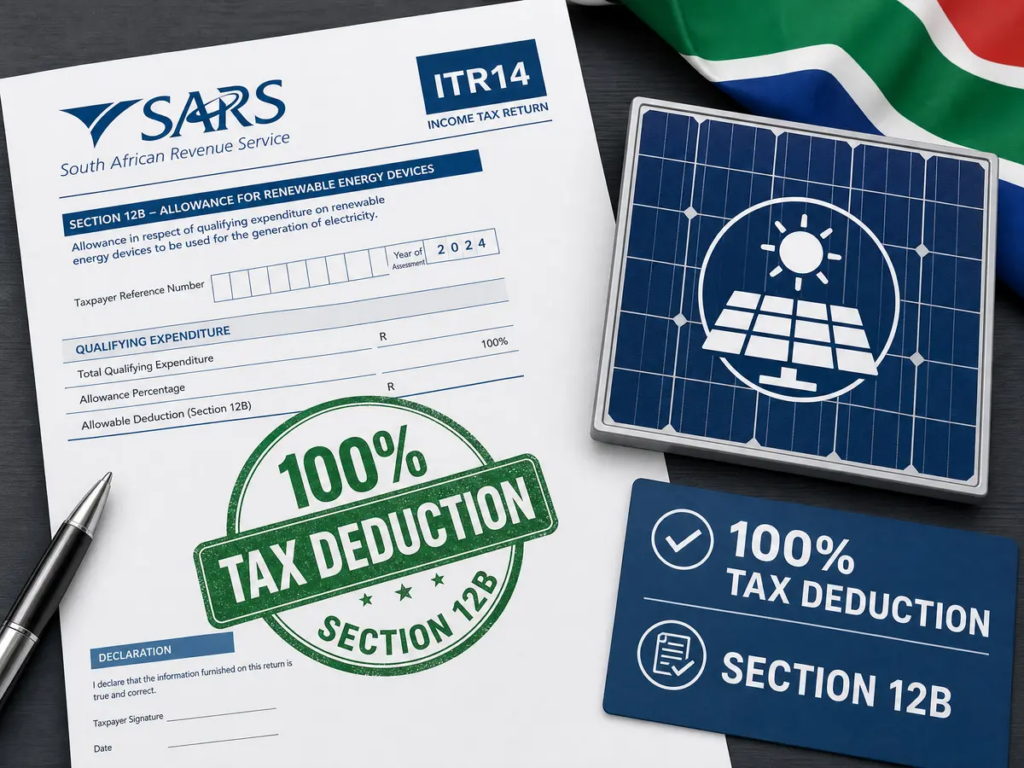
Section 12B of the Income Tax Act allows a business to deduct 100% of the cost of a qualifying solar PV system (up to 1 MW) in the first year.
Unlike normal assets that depreciate over many years, you write the whole thing off in year one, which can dramatically reduce your taxable income for that year.
Section 12B is permanent legislation — it’s still available in 2026 with no expiry date.
An important correction: between March 2023 and February 2025, there was an enhanced incentive — Section 12BA — that allowed a 125% deduction.
That enhanced allowance expired on 28 February 2025 and was not renewed.
If you read an article or get advice telling you to claim 125%, it’s out of date. The current benefit is the still-very-worthwhile 100% year-one deduction under Section 12B.
There’s often a second benefit on top: VAT-registered businesses can usually reclaim the input VAT on the purchase and installation. Integrated battery storage that forms part of the generating system generally also qualifies under Section 12B.
Please note:
Tax rules change and every business’s situation is different. Allsolar designs and installs compliant systems and provides the itemised documentation SARS expects, but your accountant or a registered tax practitioner should confirm exactly what you can claim before you commit.
Your solar installer should never be your only source of tax advice.
Sometimes… but it’s rarely the main reason to go solar, and the economics deserve a reality check.
A growing number of municipalities (including Cape Town, Johannesburg’s City Power and Tshwane) now allow registered businesses to feed surplus solar power back into the grid for a credit.
The catch is the rate: business feed-in tariffs sit around 70 to 75 cents per kWh, while you pay well over R3 per kWh to buy power back.
In other words, the power you export is worth far less than the power you consume.
The lesson is straightforward: a solar system should be designed to maximise the power you use yourself, not to sell back.
Feeding excess into the grid is a nice bonus on a sunny weekend when the business is quiet, not a business model. Selling back also requires municipal registration and a bi-directional meter, so it’s worth confirming what your specific municipality allows.
An honest answer matters here, because solar isn’t the right fit for every site. It may not pay off well if:
A proper energy audit will tell you honestly which camp you fall into — and a reputable installer will tell you if solar *isn’t* your best move.
Every business has a different load profile, roof, budget and tariff, so there’s no single answer that fits all. The starting point is always understanding your actual energy usage: how many units (kWh) you consume, and crucially, when you consume them.
At Allsolar, this is exactly what an energy audit is for.
We measure or analyse your real consumption, then design a system around it rather than selling you an off-the-shelf box. Because our designs are modular and expandable, you don’t have to fund everything at once, you can start with the system that covers your most important loads and scale it up as your budget or needs grow.
That modular approach is one of the simplest ways to make commercial solar affordable from day one.
We’ve been in the renewable energy industry since 2012, with more than 30 branches across Southern Africa, and every installation conforms to the relevant South African safety and grid-interconnection standards (NRS-097, SANS-10142-1 and others), which also keeps your insurer happy.
Is commercial solar still worth it in South Africa now that load shedding has ended?
Yes! The financial case no longer depends on load shedding at all. With electricity tariffs rising 12–15% a year, solar lets a business lock in a lower, predictable cost of power for 20+ years, while claiming a 100% first-year tax deduction under Section 12B.
How much does a commercial solar system cost?
As a 2026 guide, expect roughly R400,000–R900,000 for a small system (20–50 kW), R900,000–R2,500,000 for a medium system (50–150 kW), and R2,500,000+ for large installations. Battery storage is the biggest cost variable. An energy audit gives an accurate, site-specific figure.
How long does commercial solar take to pay for itself?
Typically three to seven years, depending on your electricity spend and how much daytime usage the system offsets. Businesses with high daytime consumption can see payback in as little as two to three years, after which the power is essentially free for the system’s remaining lifespan.
Can my business claim a tax deduction on solar?
Yes! Under Section 12B, a business can deduct 100% of the cost of a qualifying solar PV system (up to 1 MW) in the first year. VAT-registered businesses can usually also reclaim input VAT. The enhanced 125% allowance (Section 12BA) expired on 28 February 2025. Confirm specifics with a registered tax practitioner.
Do I need batteries for a commercial solar system?
Not always. If your business mainly uses power during the day, a grid-tied system without batteries offers the fastest payback. Batteries are worth adding if you need to run loads at night or want backup independence — but they increase the upfront cost.
Can I start small and expand later?
Yes! Allsolar uses a modular, expandable design approach, so you can begin with a system that covers your priority loads and add capacity as your needs or budget grow, rather than funding everything upfront.
The figures in this guide are realistic 2026 averages, but the only way to know what solar is worth for your business is to look at your actual energy use, roof and tariff.
Allsolar offers energy audits and turnkey commercial solar solutions, from professional system design and supply through to installation, integration and ongoing maintenance, backed by a nationwide network of more than 30 branches.
If you’d like an indication of costs and savings tailored to your premises, contact your nearest Allsolar branch and request a quotation.
There’s no obligation, just clear, honest information to help you make the right call.
*This article is intended as general information and reflects the South African solar market as of mid-2026. Costs, tariffs and tax rules change over time. For tax matters, please consult a registered tax practitioner.*
2025 ALLSOLAR.ALL RIGHTS RESERVED
Scroll Up