
Short answer:
Most commercial solar systems in South Africa pay for themselves in three to seven years.
Businesses with high daytime electricity use (retail, manufacturing, cold storage, offices) often see payback in under three years, especially once the Section 12B tax deduction is factored in.
After that break-even point, the system produces electricity at a fraction of grid cost for the remaining 15 to 20 years of its life.
Put differently: commercial solar isn’t an expense, it’s an investment with a measurable return, typically a 12% to 16% annual return in South Africa, and often higher for the right site.
This guide explains how payback is calculated, what makes it faster or slower, and how to work out the number for your own business.
For a well-designed commercial system in South Africa, expect a payback period in the region of three to seven years.
Where you land in that range depends mostly on how much of your power you use during daylight hours and what you currently pay Eskom.
For context, a properly sized system can cut a business’s Eskom bill by 50% to 90%. The bigger that reduction, and the higher your tariff, the faster the system pays itself off.
At its simplest, the payback period is just:
System cost ÷ annual electricity savings = payback period (in years)
So a R1,000,000 system that saves R250,000 a year in electricity has a simple payback of four years.
But that simple calculation understates the real return, because it ignores three things that work in your favour:
Factor those in and the true return is considerably better than the headline number suggests.
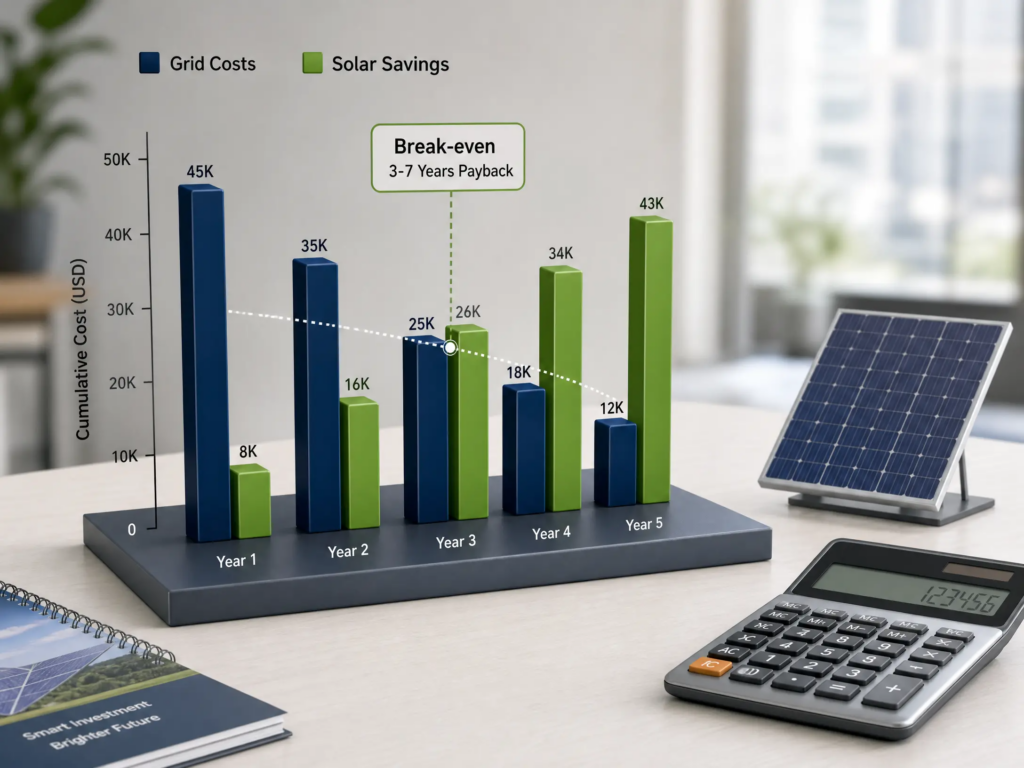
Let’s use a R1,000,000 commercial system that saves a business roughly R250,000 a year in electricity:
Simple payback (before tax): R1,000,000 ÷ R250,000 = 4 years
Payback after the Section 12B deduction: At the 27% corporate tax rate, the 100% Section 12B deduction saves about R270,000 in tax in year one, lowering the effective cost to roughly R730,000. R730,000 ÷ R250,000 = just under 3 years
And it gets better each year. Because Eskom’s tariffs keep climbing, that R250,000 annual saving grows over time, so the real payback is faster still, and every year after break-even puts more money back on your bottom line.
A business with very high daytime consumption and excellent self-use of its solar power can do even better, paybacks comfortably under three years before tax are common in retail and manufacturing, where the load lines up neatly with the hours the sun is shining.
Two identical-looking systems can have very different paybacks. These are the factors that decide it:
1. How much power you use during the day (self-consumption). This is the single biggest driver. Solar produces during daylight, so the more of that power your business uses directly — rather than exporting it cheaply to the grid — the more you save at the full retail rate. A business that runs hard from 8am to 5pm gets the fastest payback.
2. Your current electricity tariff. The more you pay Eskom per unit, the more each solar unit saves you. High-tariff users break even fastest.
3. The system cost. A competitively priced, well-designed system pays back sooner. (This is why comparing quotes on a cost-per-kW basis matters —> see our guide on what commercial solar costs.)
4. Whether you need batteries. Batteries add cost and therefore lengthen payback. They’re worth it for night-time loads or backup, but a daytime-only business often gets a faster return from a grid-tied system without them.
5. The Section 12B tax benefit. Claiming the 100% first-year deduction meaningfully shortens payback — more on this below.
Here’s the part many business owners overlook: your payback period is calculated against today’s electricity price — but that price keeps rising.
South African electricity tariffs have been climbing in the region of 8% to 15% a year, and further increases are already approved. Every time Eskom raises its rates, the value of the power your solar system produces goes up, which means your annual saving grows and your payback shortens.
In other words, the case for solar improves with every tariff hike.
A system that looks like a six-year payback at today’s prices may well pay back faster as tariffs climb and the savings after break-even compound year after year.
Payback tells you when you break even. ROI tells you what you earn after that — and over a system’s life, that’s where the real value sits.
Most commercial solar installations in South Africa deliver an annual return (ROI/IRR) in the region of 12% to 16%, with well-matched, high-daytime-usage sites achieving more.
For comparison, that’s a strong, low-risk return that often outperforms many conventional investment options and unlike the stock market, it’s a return you generate by not spending on something you’d have to buy anyway.
Consider the full picture on that R1,000,000 system:
That’s why solar is best understood not as a cost, but as a long-term, inflation-beating asset on your balance sheet. (For the broader picture of whether it’s the right move for your business, see our guide on whether solar is worth it.)
Significantly. The Section 12B allowance lets a business deduct 100% of a qualifying solar system’s cost (up to 1 MW) in the first year, which reduces your effective cost — and therefore your payback period — straight away.
On our R1,000,000 example, the roughly R270,000 in year-one tax relief cut the effective payback from four years to under three. VAT-registered businesses can usually reclaim the input VAT on top, shortening it further. (We cover exactly how this works in our guide to the Section 12B solar tax deduction.)
As always, confirm your specific tax position with a registered tax practitioner.
It changes your cash flow, which is just as important.
With cash purchase, you own the asset, claim the full Section 12B benefit, and enjoy the fastest pure payback.
With asset finance, you spread the cost — and because monthly repayments can often be structured to be lower than your current electricity bill, many businesses are cash-flow positive from month one, even while the system is still being paid off.
The right approach depends on your cash position and tax appetite, which is a decision worth taking with your accountant.
For balance, solar pays back more slowly when:
A proper energy audit catches all of these before you spend a cent, which is exactly why it’s the right place to start.
The ranges in this guide are realistic averages, but your actual payback depends on your specific load profile, tariff and roof.
The only way to get an accurate figure is to look at how much power you use and crucially, when you use it.
At Allsolar, that’s what an energy audit is for: we analyse your real consumption and design a system sized to maximise the power you use directly, which is what drives the fastest payback.
Because our designs are modular and expandable, you can also phase your investment while still capturing the year-one tax benefit on each stage.
With more than 30 branches across Southern Africa and roots in the industry since 2012, we’ll show you the projected payback and savings for your specific site — not a generic estimate.
How long does commercial solar take to pay for itself in South Africa? Most commercial systems pay back in three to seven years. Businesses with high daytime electricity use often reach break-even in under three years, particularly once the Section 12B tax deduction is applied. After payback, the system generates low-cost power for another 15 to 20 years.
What is the ROI on commercial solar for a business? South African commercial solar typically delivers an annual return (ROI/IRR) of around 12% to 16%, with well-matched high-daytime-usage sites achieving more. Over a 20-year-plus lifespan, cumulative savings usually run to several times the system’s original cost.
How is solar payback calculated? The simple calculation is system cost divided by annual electricity savings. A R1,000,000 system saving R250,000 a year has a simple payback of four years. Factoring in the Section 12B deduction and rising tariffs shortens the real payback considerably.
Does the Section 12B tax deduction shorten the payback period? Yes. The 100% first-year deduction lowers your effective system cost — on a R1,000,000 system, the roughly R270,000 in year-one tax relief can cut payback from about four years to under three. VAT-registered businesses can shorten it further by reclaiming input VAT.
Does payback get faster as electricity prices rise? Yes. Payback is measured against today’s tariff, but tariffs keep rising (around 8% to 15% a year). Each increase raises the value of the power your system generates, growing your annual saving and shortening the payback over time.
What makes solar payback longer? Mainly night-time usage that relies on batteries, an already-low electricity bill, a short lease, or an oversized system that exports power cheaply instead of using it. An energy audit identifies these factors before you invest.
The figures here are realistic 2026 averages — but your actual payback depends on your premises, your tariff and how you use power.
Allsolar provides energy audits and turnkey commercial solar solutions — designed to maximise your savings and shorten your payback — backed by a nationwide network of more than 30 branches.
For a payback and savings projection tailored to your business, contact your nearest Allsolar branch or request a quotation.
This article is general information reflecting the South African solar market as of mid-2026. Costs, tariffs and tax rules change over time, and actual returns depend on your specific circumstances. For tax matters, please consult a registered tax practitioner.
2025 ALLSOLAR.ALL RIGHTS RESERVED
Scroll Up