Can My Business Claim Solar Tax Back? Section 12B | Allsolar

What Are the Tax Benefits of Solar for My Business in South Africa? (Section 12B, 2026)

Short Answer: Your business can claim a significant tax deduction on solar. Under Section 12B of the Income Tax Act, a business can deduct 100% of the cost of a qualifying solar PV system (up to 1 MW) in the first year.

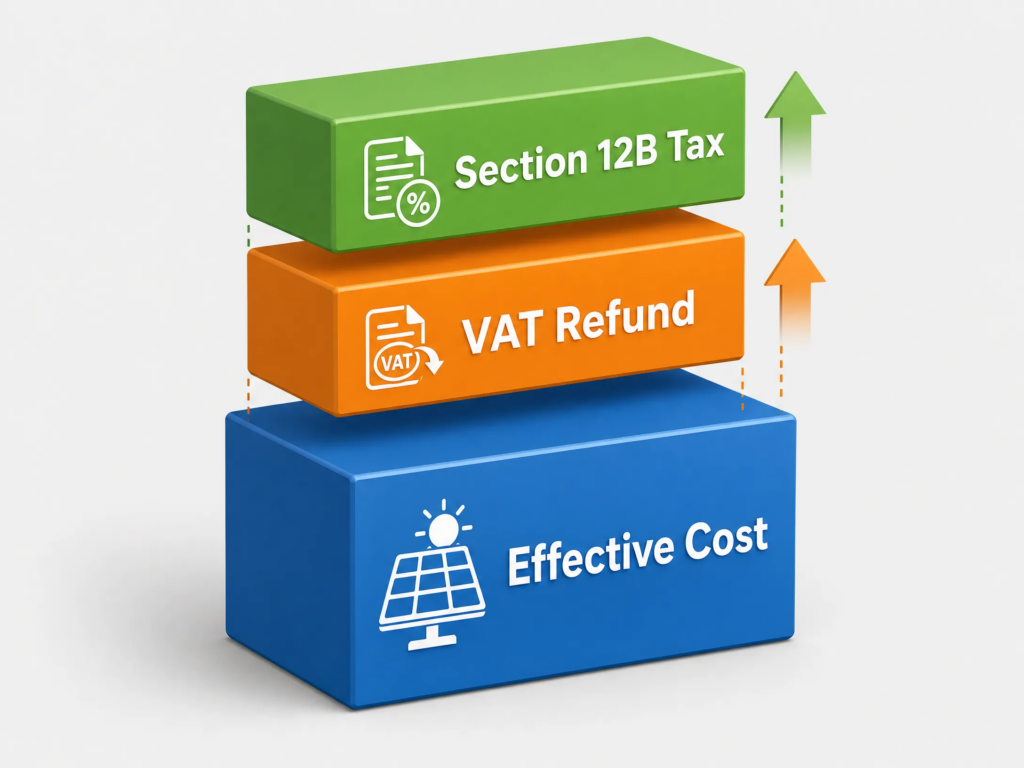
If your business is VAT-registered, you can usually also reclaim the input VAT on the purchase and installation. Combined, these two mechanisms can cut the effective cost of a commercial solar system by roughly 30% to 50% in year one.

One important correction up front, because there’s a lot of outdated information online: the enhanced 125% deduction (Section 12BA) expired on 28 February 2025 and was not renewed.

New installations now fall under the still-very-worthwhile 100% Section 12B deduction.

This guide is general information, not tax advice. Tax rules are detailed and change often… always confirm your position with a registered tax practitioner before you commit.

Can my business still claim the 125% solar tax deduction?

This is the most common point of confusion in 2026, so let’s clear it up directly: no, the 125% deduction is no longer available for new systems.

Here’s what happened.

Between 1 March 2023 and 28 February 2025, the government ran a temporary enhanced incentive called Section 12BA, which allowed businesses to deduct 125% of a renewable energy system’s cost, with no capacity cap.

It was designed to accelerate private investment during the energy crisis… and it worked.

That window has closed.

The 2025 Budget confirmed Section 12BA was not extended, so any system brought into use after 28 February 2025 does not qualify for the 125% allowance.

If an article or a salesperson tells you to claim 125% today, that information is out of date.

The good news: the permanent incentive — Section 12B — is still in place, and it’s still generous.

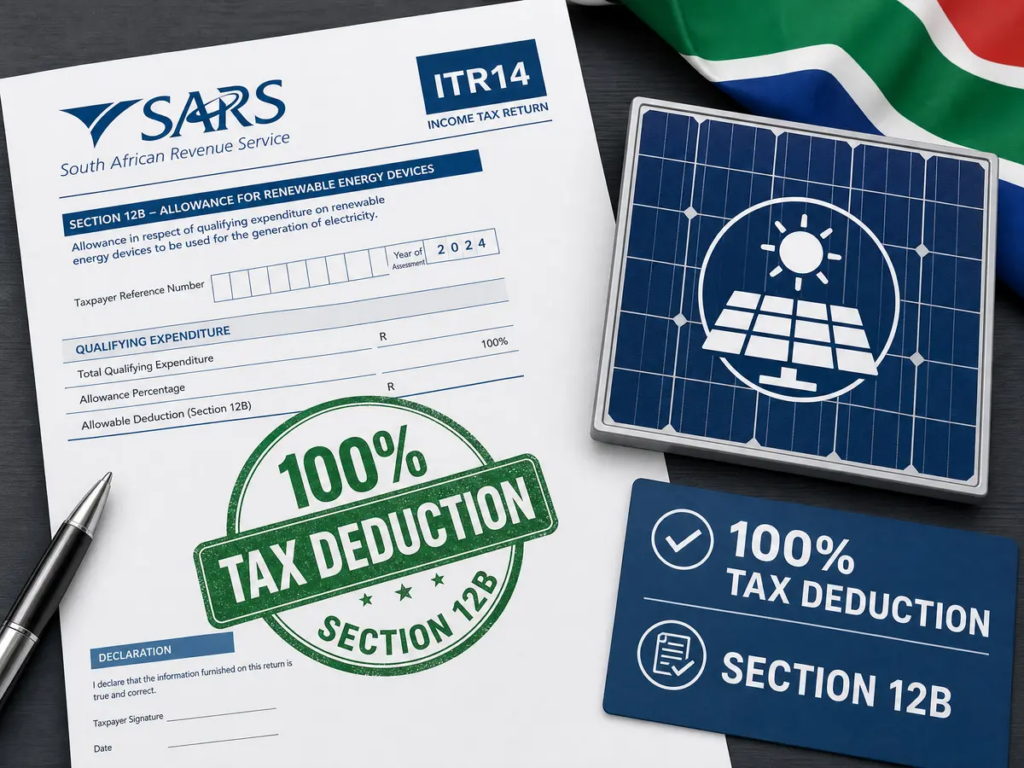
What is Section 12B and how much can I deduct?

Section 12B has been part of the Income Tax Act since 2015 and has no expiry date.

For solar PV systems up to 1 MW, it allows a business to deduct 100% of the qualifying cost in the first year the system is brought into use.

That’s the key benefit: instead of writing the asset off slowly over many years, you deduct the entire cost in year one, which can substantially reduce your taxable income for that year.

A few specifics worth knowing:

Systems up to 1 MW: 100% deduction in year one. (For solar PV, the old 50/30/20 three-year schedule no longer applies.)
Systems above 1 MW: these don’t get the 100% year-one deduction, but still qualify for an accelerated 50% / 30% / 20% write-off over three years.
– The 1 MW threshold was confirmed in the 2025 Budget and is not being revised.

For the vast majority of commercial installations, which sit well under 1 MW, that means the full cost is deductible in the first year.
How much could this actually save my business?

Let’s put real numbers to it.

South Africa’s corporate income tax rate is currently 27%.

Imagine your company installs a qualifying solar system costing R1,000,000:

– Section 12B lets you deduct the full R1,000,000 from your taxable income in year one.
– At the 27% corporate rate, that reduces your tax bill by R270,000.
– Your effective cost drops from R1,000,000 to R730,000… before you’ve saved a single rand on electricity.

For a smaller business, the effect is just as meaningful. A R400,000 system generates a R400,000 deduction, saving a company about R108,000 in tax and bringing the effective cost down to roughly R292,000.

A couple of caveats: the saving is only realised if your business has enough taxable income to absorb the deduction, and sole proprietors are deducted at their personal marginal rate (which can be higher than 27%). Your tax practitioner will confirm exactly how it applies to your entity.

Can I also claim back the VAT?

Yes… and this is a separate benefit on top of Section 12B.

If your business is a registered VAT vendor, you can generally reclaim the input VAT on the purchase and installation of your solar system, provided the system is used to make taxable supplies.

Crucially, these two benefits don’t cancel each other out. The input VAT is reclaimed on your VAT201 return (usually within a month or two of installation), while the Section 12B deduction goes on your annual income tax return. You claim both, for the same install, in the same tax year.

Stacking them is what produces the headline saving. On a system priced around R460,000 including VAT, a VAT-registered business can recover roughly R60,000 in VAT and save tax through Section 12B — bringing the true net cost down to around R232,000.

That’s close to a 50% effective reduction, assembled from two legitimate tax mechanisms.

Who qualifies, and what are the conditions?

Section 12B is available to any taxpayer carrying on a trade: private companies (Pty Ltd), close corporations, sole proprietors, partnerships and trusts all qualify.

There are three main conditions:

1. You must own the asset. Systems bought outright or financed through an instalment credit agreement (hire-purchase) qualify. If you’re on a pure operating lease, the owner of the equipment claims the allowance, not you. (This is an important detail when choosing how to finance your system.)
2. The system must be brought into use during the tax year… meaning commissioned and actually generating electricity. SARS looks closely at the commissioning date on your Certificate of Compliance, so a system installed in December but commissioned in January is claimed in the new tax year.
3. The electricity must be used in producing income. In practice, powering the premises where you run your business (shop, workshop, warehouse, office, guesthouse, factory). SARS interprets this broadly for commercial premises.

One more point: if part of your system was funded by a government grant, you can only claim the deduction on the portion you paid for yourself.

Do batteries qualify for Section 12B?

Generally, YES, provided the battery forms part of the system that generates electricity.

SARS confirmed this in a binding class ruling in 2024: batteries integrated into a renewable energy installation qualify under Section 12B because they’re part of the generating system.

The distinction that matters: a battery installed as part of your solar PV system qualifies, but a standalone storage unit used purely to store grid power, with no generation component, does not.

If storage is part of your solar design, it’s typically covered.

Does Section 12B apply to my home?

No, and this trips a lot of people up.

Section 12B is a business incentive only. Residential homeowners do not qualify for it.

There was a separate, temporary individual rebate (a 25% credit on solar panels, capped at R15,000) for the 2024 tax year, but that expired and has not been replaced.

So if you’re a homeowner, the tax angle no longer applies. If you run a business from commercial premises, Section 12B is the provision that benefits you.
What documentation does SARS expect?

Because these deductions reduce your tax bill, SARS scrutinises them, so good documentation is essential.

You’ll generally want:

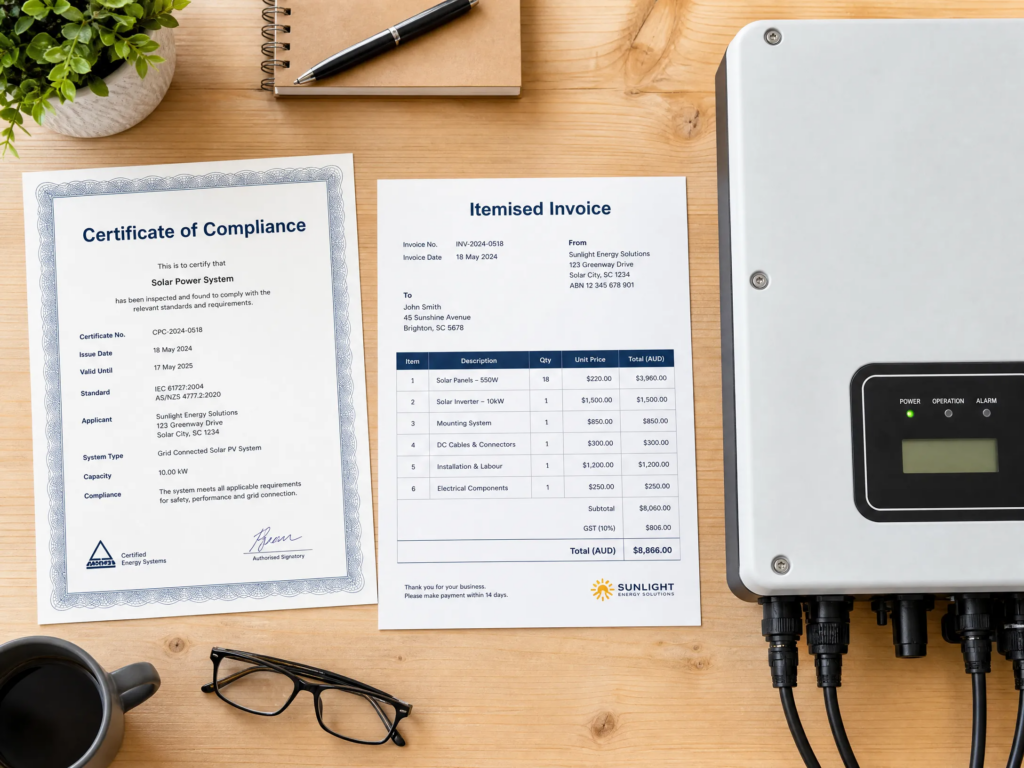
– An itemised invoice that breaks down panels, inverter, mounting, battery, labour and compliance separately. Vague “solar installation: R200,000” invoices raise audit flags; detailed ones pass scrutiny.

– A Certificate of Compliance (CoC) confirming the date the system was brought into use.

All supporting records (invoices, the CoC, proof of payment) kept for several years, since SARS can review claims well after the fact.

This is one more reason to use an installer who provides proper, itemised turnkey documentation rather than a single lump-sum quote.

How Allsolar helps you claim with confidence

Claiming Section 12B correctly starts with a compliant, properly documented installation.

At Allsolar, every system is installed to the relevant South African standards (SANS 10142-1 and the applicable grid codes), commissioned with a Certificate of Compliance, and supported by itemised documentation, exactly the paper trail SARS expects.

We begin with an energy audit to size the system correctly for your business, and our modular, expandable designs let you invest in stages while still capturing the year-one deduction on each qualifying phase.

With more than 30 branches across Southern Africa and roots in the industry since 2012, we handle the design, supply, installation and compliance — so your accountant has clean records to work from.

Important: Allsolar designs and documents compliant systems, but we are not tax practitioners.

The exact deduction your business can claim depends on your entity, income and circumstances. Always confirm your position with a registered tax practitioner — the South African Institute of Tax Professionals (SAIT) maintains a directory of accredited advisors.

Frequently asked questions

Can my business still claim the 125% solar tax deduction in 2026?
No. The 125% deduction under Section 12BA expired on 28 February 2025 and was not renewed. Systems brought into use after that date qualify for the permanent Section 12B deduction instead, which allows a 100% write-off in year one for solar PV up to 1 MW.

How much can a business deduct for solar under Section 12B?
A business can deduct 100% of the cost of a qualifying solar PV system (up to 1 MW) in the first year it is brought into use. At the 27% corporate tax rate, a R1,000,000 system produces a tax saving of around R270,000, lowering the effective cost to about R730,000.

Can I claim Section 12B and the VAT back at the same time?
Yes. The two benefits are separate. VAT-registered businesses reclaim input VAT on the VAT201 return, while the Section 12B deduction is claimed on the annual income tax return. Both can apply to the same installation in the same tax year.

Who qualifies for the Section 12B solar deduction?
Any taxpayer carrying on a trade; companies, close corporations, sole proprietors, partnerships and trusts. The system must be owned (or financed via instalment credit), commissioned and generating during the tax year, and used to produce income.

Do batteries qualify for the Section 12B deduction?
Yes, when the battery forms part of the solar PV system that generates electricity. SARS confirmed this in a 2024 binding class ruling. Standalone storage units with no generation component do not qualify.

Does Section 12B apply to homeowners?
No. Section 12B is a business incentive only. The temporary individual solar rebate applied to the 2024 tax year and has expired with no replacement.

Want to understand your solar tax benefit?

Section 12B can meaningfully reduce the cost of going solar, but the exact figure depends on your business, and the system has to be correctly designed, commissioned and documented to qualify.

Allsolar provides energy audits and fully compliant, itemised turnkey commercial solar installations… backed by a nationwide network of more than 30 branches, giving you and your accountant a clean foundation for your claim.

To explore what solar (and its tax benefits) could mean for your business, contact your nearest Allsolar branch or request a quotation.

*This article is general information reflecting the South African tax position as of mid-2026. Tax legislation changes and individual circumstances differ. Allsolar is not a registered tax practitioner — please consult one before making decisions based on tax relief.*
Nico Smit

Commercial Solar Cost in South Africa: 2026 Price Guide | Allsolar

How Much Does Commercial Solar Cost in South Africa? (2026 Guide)

Short answer: A commercial solar system in South Africa typically costs between R400,000 and R2,500,000+ in 2026, depending on size.

As a rule of thumb, expect to pay roughly R12,000 to R18,000 per kW installed — with the cost per kW dropping as the system gets bigger. Battery storage is the single biggest factor that pushes the price up.

That’s the headline.

But a solar system isn’t an off-the-shelf product with one price tag… two quotes for the “same” system can differ by 30% to 50%. This guide breaks down exactly what you’re paying for, what drives the cost up or down, and how to compare quotes properly so you know you’re getting a fair deal.

What does commercial solar cost, by system size?

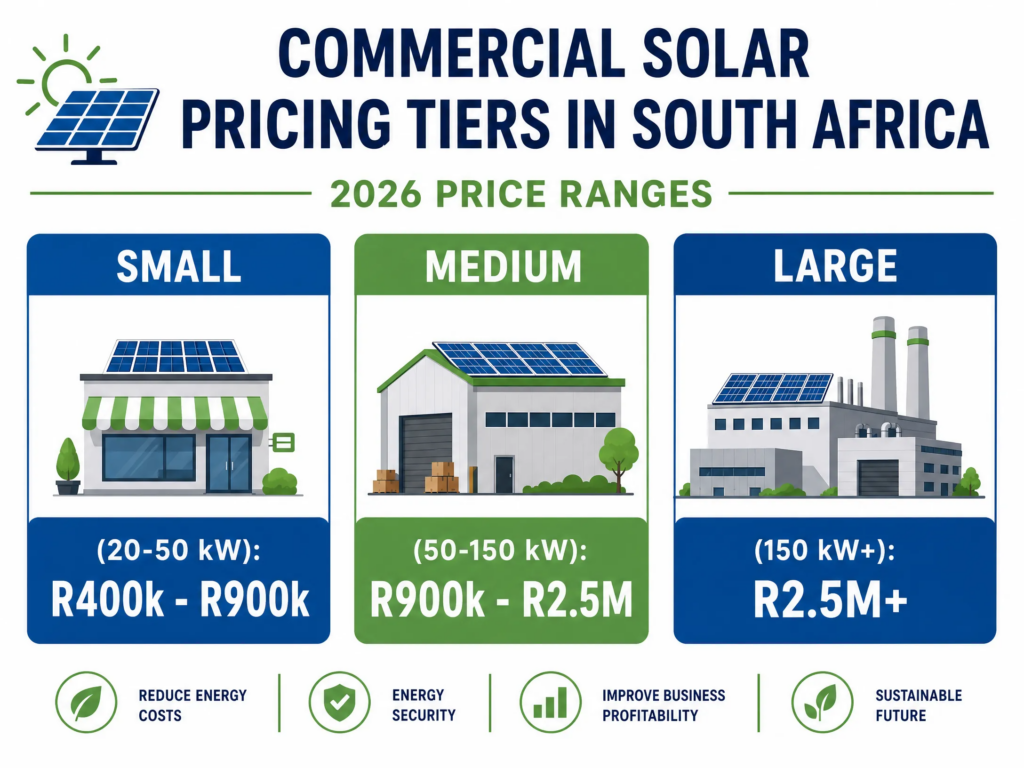
Here are realistic 2026 price ranges for commercial installations in South Africa:

System Size

Typical Use Case

Indicative Cost

Small (20–50 kW)

Offices, retail shops, workshops

R400,000 – R900,000

Medium (50–150 kW)

Warehouses, guesthouses, mid-size manufacturers

R900,000 – R2,500,000

Large (150 kW+)

Factories, cold storage, large commercial sites

R2,500,000 and above

These figures are for fully installed systems, not just the hardware.

Where your project lands within (or beyond) these ranges depends mostly on whether you need batteries, your roof or site conditions, and the quality of components you choose.

What's actually included in the price?

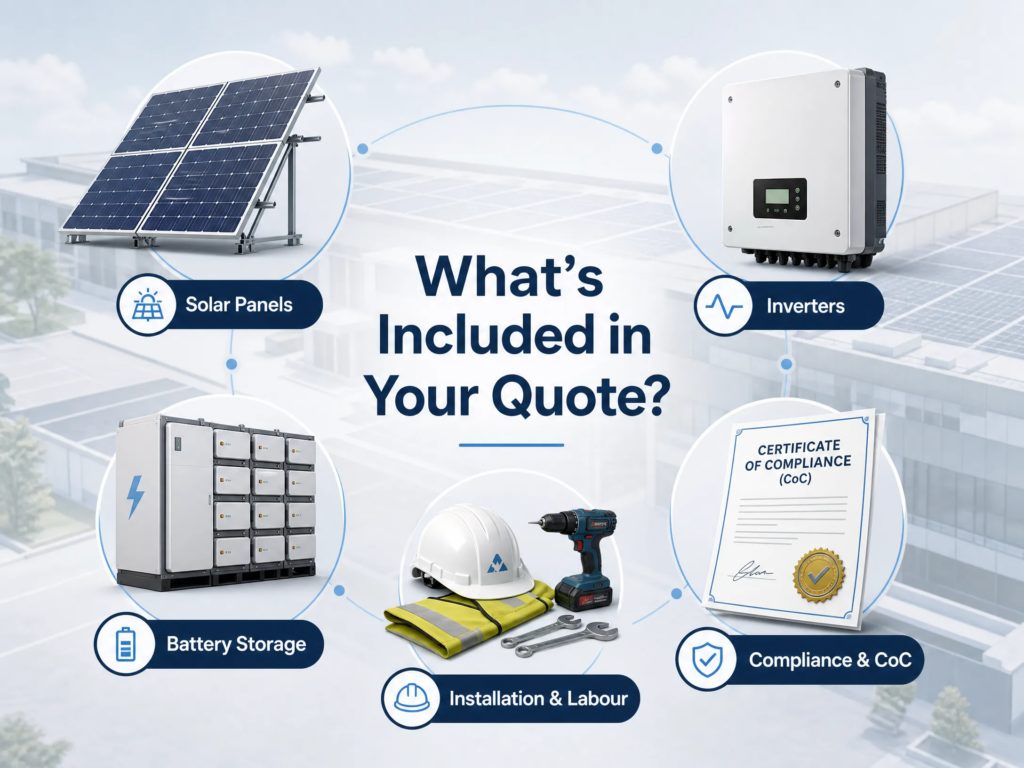
When you get a commercial solar quote, you’re paying for a complete, engineered system — not a box of panels.

A proper installed price includes:

  • Solar panels — usually the most visible cost, but often not the largest.
  • Inverter(s) — the “brain” that converts DC from the panels into usable AC power. Commercial sites often need multiple inverters or three-phase units.
  • Mounting structures — rails and brackets for your roof type, or ground-mount frames.
  • Cabling, protection and electrical components — DC and AC cabling, circuit breakers, surge protection.
  • Battery storage — optional, and the biggest single cost variable (more below).
  • Installation labour — typically 15% to 25% of the total system cost.
  • Commissioning, monitoring and compliance — a Certificate of Compliance (CoC), system testing and grid-tie (NERSA / Eskom) registration.
 

A trustworthy quote separates these out on an itemised line-item basis.

If a quote is a single “all-inclusive” number with no breakdown, that’s a red flag, you can’t compare it fairly or see where corners might be cut.

Why "cost per kW" matters more than the sticker price

The cleanest way to compare commercial solar quotes is cost per kW installed (sometimes shown as cost per Wp, or watt-peak). You simply divide the total system price by the system’s kW rating.

This matters because a bigger headline price isn’t necessarily a worse deal.

In fact, the cost per kW falls as systems get larger:

  • A smaller commercial system might cost around R16,000 to R18,000 per kW.
  • A larger system can come down to R12,000 to R15,000 per kW or less.
 

This is why undersizing to save money upfront often costs you more in the long run. A slightly larger system usually delivers a better cost per kW and more lifetime savings.

When you compare quotes, normalise them to cost per kW and you’ll quickly see which is genuinely competitive.

What makes one quote so different from another?

If you collect a few quotes, you’ll notice the prices vary… sometimes dramatically.

Here’s what’s behind that:

    1. Battery storage (the big one). Batteries are the most expensive component in any solar system. A grid-tied system with no batteries is far cheaper than a hybrid system designed to store power for after dark. Whether you need batteries comes down to when your business uses electricity, which is the single most important question in sizing a commercial system.
    2. Component quality (panel and inverter tier). Tier 1 panels and premium inverters (the brands installers trust for 20-plus-year lifespans) cost more upfront but come with longer warranties and better performance. Budget components can make sense for short-horizon or secondary sites, but on a system you’ll run for two decades, the premium is usually worth it.
    3. Roof versus ground mount, and roof type. A simple, accessible roof is cheaper to work with than a complex, fragile, or heavily shaded one. Ground-mounted systems add the cost of framing and groundwork. Older roofs may need reinforcement before installation.
    4. Single-phase versus three-phase. Most commercial sites run three-phase power, which requires compatible (and pricier) inverters and a more involved installation than a typical home.
    5. Grid-tied, hybrid, or off-grid. Grid-tied (no battery) is cheapest. Hybrid (with battery backup) costs more. Fully off-grid is the most expensive and rarely necessary now that the grid is stable.
    6. Site complexity and location. Long cable runs, distribution-board upgrades, and transport to remote sites all add cost.

The hidden costs businesses forget to budget for

The system price is the bulk of it, but a few additional costs catch businesses off guard:

  • Compliance and certification. Every installation needs a CoC and must meet South African standards (SANS 10142-1 and the relevant grid-interconnection codes, NRS-097). This isn’t optional and it’s the costliest corner to cut, because a non-compliant system can void your insurance and block a future property sale.
  • Grid registration. Commercial systems generally must be registered with your municipality or Eskom (and sometimes NERSA). Requirements and any associated fees vary by area, so confirm what applies to your site.
  • Structural work. Roof repairs or reinforcement, if needed before mounting.
  • Maintenance. Solar is low-maintenance, but budget for occasional panel cleaning and periodic inspections to keep performance and warranties intact.
  • Monitoring. Most modern systems include monitoring, but confirm it’s part of your quote.
 

The good news: a reputable turnkey installer folds compliance, registration and commissioning into the quote, so there are no surprises later.

What's the real cost after the tax deduction?

Here’s something many business owners miss: the sticker price isn’t your true cost.

Under Section 12B of the Income Tax Act, a business can deduct 100% of the cost of a qualifying solar PV system (up to 1 MW) in the first year. For a company paying tax at 27%, that deduction meaningfully reduces the effective cost of the system in year one.

VAT-registered businesses can usually also reclaim the input VAT on the purchase and installation.

So a system with a R1,000,000 price tag can have a substantially lower effective cost once the tax benefit is applied. 

(Note: the enhanced 125% allowance under Section 12BA expired on 28 February 2025 — the current benefit is the still-valuable 100% deduction. Always confirm the specifics with a registered tax practitioner.)

How does the cost compare to what you save?

Cost only means something next to savings.

With Eskom tariffs above R3 per kWh and rising 12% to 15% a year, a well-designed commercial system generates power at a fraction of grid cost… often around R1 per kWh once you account for the system’s lifespan.

For most businesses, that translates to a payback period of three to seven years, after which the power is essentially free for the remaining 15 to 20 years of the system’s life.

A business with high daytime electricity use can see even faster payback. (We cover the savings maths in detail in our guide on whether solar is worth it for your business.)

In other words: the cost is real, but for most commercial sites it’s an investment that pays itself back and then keeps paying.

How do I get an accurate price for my business?

Every business has a different roof, load profile, tariff and budget… so the only way to get a real number is a proper assessment of your site.

The starting point is always an energy audit: understanding how many units (kWh) you use, and crucially when you use them, so the system is sized correctly rather than over- or under-built.

A few tips to get a fair, accurate price:

  • Get an itemised quote that separates panels, inverter, battery, mounting, labour and compliance.
  • Compare on cost per kW, like-for-like (same system size, same battery capacity, same component tier).
  • Check credentials — proper electrical certification, compliance with SANS standards, and local references.
 

At Allsolar, we start with an energy audit and design a system around your actual usage, with a transparent, itemised turnkey quote — covering design, supply, installation, integration and ongoing maintenance.

Because our designs are modular and expandable, you don’t have to fund everything at once: you can start with the system that covers your priority loads and scale up as your budget allows, which is one of the most practical ways to manage the upfront cost.

We’ve been in renewable energy since 2012, with more than 30 branches across Southern Africa, and every installation meets the relevant South African safety and grid standards.

Frequently asked questions

How much does a commercial solar system cost in South Africa? In 2026, expect roughly R400,000–R900,000 for a small system (20–50 kW), R900,000–R2,500,000 for a medium system (50–150 kW), and R2,500,000+ for large installations. Installed costs work out to around R12,000–R18,000 per kW, with the per-kW cost falling as the system gets bigger.

What is the cost per kW of commercial solar? Commercial solar costs roughly R12,000 to R18,000 per kW installed in 2026. Smaller systems sit at the higher end; larger systems benefit from economies of scale and come down toward R12,000–R15,000 per kW or lower.

Why are some solar quotes so much cheaper than others? Price differences usually come down to battery storage, component quality (Tier 1 versus budget panels and inverters), roof or site complexity, and whether compliance and certification are included. Always compare itemised quotes on a cost-per-kW basis rather than the headline figure.

What’s the biggest cost in a commercial solar system? For systems with storage, the battery bank is usually the most expensive single component. A grid-tied system without batteries is significantly cheaper, so the right design depends on whether your business needs power after dark.

Does the price include installation and compliance? A proper turnkey quote includes installation labour, commissioning, a Certificate of Compliance (CoC) and grid registration. Be wary of hardware-only prices that exclude these essential — and legally required — components.

Can I reduce the cost with tax incentives? Yes. Section 12B allows a business to deduct 100% of a qualifying solar PV system’s cost (up to 1 MW) in the first year, and VAT-registered businesses can usually reclaim input VAT — lowering the effective cost considerably. Confirm specifics with a registered tax practitioner.

Want an accurate price for your business?

The ranges in this guide are realistic 2026 averages — but your actual cost depends on your premises, your energy use and the system that’s right for you.

Allsolar provides energy audits and transparent, itemised turnkey commercial solar quotes — from system design and supply through to installation, integration and maintenance — backed by a nationwide network of more than 30 branches.

If you’d like a clear, no-obligation cost estimate tailored to your site, contact your nearest Allsolar branch or request a quotation.

This article is intended as general information and reflects the South African solar market as of mid-2026. Costs, tariffs and tax rules change over time. For tax matters, please consult a registered tax practitioner.

Nico Smit

Commercial Solar in South Africa: Is It Worth It? (2026 Guide)

Is Solar Worth It for My Business in South Africa? (2026 Guide)

Short answer: Yes! 

For most South African businesses, commercial solar is still a sound investment in 2026.

But the reason has changed.

With load shedding largely behind us, the case for going solar is no longer about keeping the lights on during blackouts. It’s now about protecting your business from relentless electricity price increases, claiming significant tax deductions, and locking in a lower cost of power for the next 20 to 25 years.

Whether it’s worth it for your specific business depends on how much electricity you use during daylight hours, your roof or ground space, and your current tariff. This guide walks through the real numbers so you can make an informed decision.

If load shedding is over, why bother with solar?

This is the question on every business owner’s mind in 2026, and it’s a fair one.

South Africa passed 300 consecutive days without load shedding in March 2026, and the government has effectively declared the energy crisis over. So if the grid is stable, why spend money on solar?

Because the backup argument and the savings argument are two very different things.

Load shedding was always the dramatic, visible problem. The quieter, more permanent problem is the cost of grid electricity, which continues to climb at roughly 12% to 15% per year.

Eskom tariffs now sit above R3.50 per kWh for many users, and further increases have already been approved for the 2026, 2027 and 2028 financial years.

For a business, that’s a cost line that only ever goes up — and one you have almost no control over.

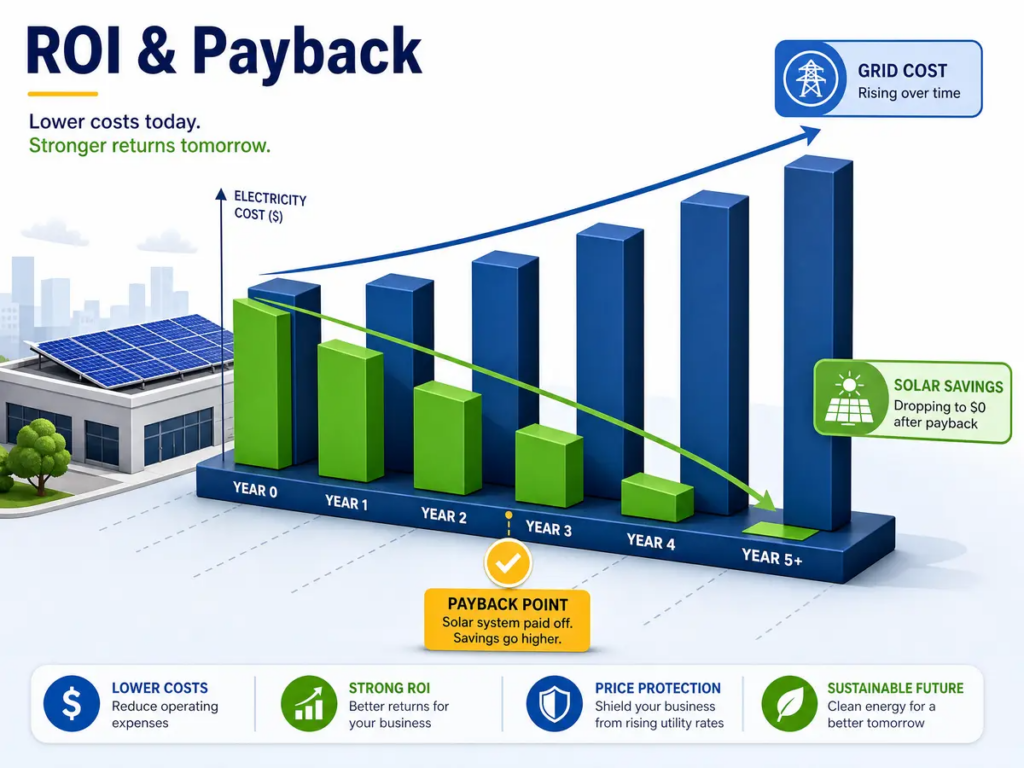
Solar changes that. Once your system is paid off, the power it produces is effectively free for the remaining 15 to 20 years of its life.

You’re swapping an unpredictable, ever-rising expense for a fixed, known one. That’s the real reason commercial solar still makes sense, even in a country that has put the worst of its blackouts behind it.

The simple way to think about it: Load shedding made solar urgent. Rising tariffs make it smart.

How much does commercial solar cost in South Africa?

Commercial solar pricing varies widely depending on system size, whether you include battery storage, your roof structure, and grid-connection requirements.

As a general guide for South African businesses in 2026:

System Size

Typical Use Case

Indicative Cost

Small (20–50 kW)

Small offices, retail shops, workshops

R400,000 – R900,000

Medium (50–150 kW)

Warehouses, guesthouses, mid-size manufacturers

R900,000 – R2,500,000

Large (150 kW+)

Factories, cold storage, large commercial sites

R2,500,000 and above

These ranges typically include panels, inverters, mounting structures, cabling and, where required, a battery bank. The single biggest cost variable is usually battery storage.

A grid-tied system with no batteries is considerably cheaper than a hybrid system designed to run through the night, so the right design comes down to when your business actually uses power.


A useful detail many business owners miss: the cost per kW drops as systems get bigger. Oversizing slightly for future growth is often more economical than undersizing to save on the initial outlay.


These are indicative 2026 market figures. The only way to get an accurate price is a proper energy audit of your specific site, which is where we’d usually start.

What's the payback period and ROI on commercial solar?

For most South African businesses, commercial solar pays for itself within three to seven years, then continues generating power for another 15 to 20 years after that.

The exact payback depends on how much you currently spend on electricity and how much of your usage solar can offset.

Here’s a simplified, real-world example:

  • A business spends R150,000 per month on electricity.
  • A well-designed solar system reduces that bill by R120,000 per month.
  • The system costs R3,800,000.
  • Payback period: roughly two and a half years.
 

After that point, the business is saving over a million rand a year in electricity costs… savings that grow every single time Eskom raises its tariffs.

Over a 20-year horizon, the total saving runs well into the tens of millions for a business of this size.

The businesses that see the fastest payback are those that use most of their power during the day, when the sun is shining: manufacturers, cold storage, retail, agriculture, offices.

If your operation runs mainly at night, solar still works, but it usually needs batteries, which changes the maths.

The tax angle: what can my business actually claim?

This is where commercial solar gets genuinely attractive, and where there’s a lot of outdated information floating around… so it’s worth getting right.

Section 12B of the Income Tax Act allows a business to deduct 100% of the cost of a qualifying solar PV system (up to 1 MW) in the first year.

Unlike normal assets that depreciate over many years, you write the whole thing off in year one, which can dramatically reduce your taxable income for that year.

Section 12B is permanent legislation — it’s still available in 2026 with no expiry date.

An important correction: between March 2023 and February 2025, there was an enhanced incentive — Section 12BA — that allowed a 125% deduction.

That enhanced allowance expired on 28 February 2025 and was not renewed.

If you read an article or get advice telling you to claim 125%, it’s out of date. The current benefit is the still-very-worthwhile 100% year-one deduction under Section 12B.

There’s often a second benefit on top: VAT-registered businesses can usually reclaim the input VAT on the purchase and installation. Integrated battery storage that forms part of the generating system generally also qualifies under Section 12B.

Please note:

Tax rules change and every business’s situation is different. Allsolar designs and installs compliant systems and provides the itemised documentation SARS expects, but your accountant or a registered tax practitioner should confirm exactly what you can claim before you commit.

Your solar installer should never be your only source of tax advice.

Can my business sell excess solar power back to the grid?

Sometimes… but it’s rarely the main reason to go solar, and the economics deserve a reality check.

A growing number of municipalities (including Cape Town, Johannesburg’s City Power and Tshwane) now allow registered businesses to feed surplus solar power back into the grid for a credit.

The catch is the rate: business feed-in tariffs sit around 70 to 75 cents per kWh, while you pay well over R3 per kWh to buy power back.

In other words, the power you export is worth far less than the power you consume.

The lesson is straightforward: a solar system should be designed to maximise the power you use yourself, not to sell back.

Feeding excess into the grid is a nice bonus on a sunny weekend when the business is quiet, not a business model. Selling back also requires municipal registration and a bi-directional meter, so it’s worth confirming what your specific municipality allows.

When is solar *not* worth it for a business?

An honest answer matters here, because solar isn’t the right fit for every site. It may not pay off well if:

  • Your business uses very little power during daylight hours. If you only operate at night, you’ll lean heavily on batteries, which lengthens the payback.
  • You’re on a short lease with no buy-in from the landlord. Solar is a long-term asset best suited to premises you’ll occupy for years.
  • Your roof is unsuitable heavily shaded, structurally weak, or too small — with no ground-mount alternative.
  • Your electricity bill is already very low. If you’re spending a few thousand rand a month, the savings may not justify the capital outlay.

A proper energy audit will tell you honestly which camp you fall into — and a reputable installer will tell you if solar *isn’t* your best move.

How do I know if solar is right for my specific business?

Every business has a different load profile, roof, budget and tariff, so there’s no single answer that fits all. The starting point is always understanding your actual energy usage: how many units (kWh) you consume, and crucially, when you consume them.

At Allsolar, this is exactly what an energy audit is for.

We measure or analyse your real consumption, then design a system around it rather than selling you an off-the-shelf box. Because our designs are modular and expandable, you don’t have to fund everything at once, you can start with the system that covers your most important loads and scale it up as your budget or needs grow.

That modular approach is one of the simplest ways to make commercial solar affordable from day one.

We’ve been in the renewable energy industry since 2012, with more than 30 branches across Southern Africa, and every installation conforms to the relevant South African safety and grid-interconnection standards (NRS-097, SANS-10142-1 and others), which also keeps your insurer happy.

Frequently asked questions

Is commercial solar still worth it in South Africa now that load shedding has ended?
Yes! The financial case no longer depends on load shedding at all. With electricity tariffs rising 12–15% a year, solar lets a business lock in a lower, predictable cost of power for 20+ years, while claiming a 100% first-year tax deduction under Section 12B.

How much does a commercial solar system cost?
As a 2026 guide, expect roughly R400,000–R900,000 for a small system (20–50 kW), R900,000–R2,500,000 for a medium system (50–150 kW), and R2,500,000+ for large installations. Battery storage is the biggest cost variable. An energy audit gives an accurate, site-specific figure.

How long does commercial solar take to pay for itself?
Typically three to seven years, depending on your electricity spend and how much daytime usage the system offsets. Businesses with high daytime consumption can see payback in as little as two to three years, after which the power is essentially free for the system’s remaining lifespan.

Can my business claim a tax deduction on solar?
Yes! Under Section 12B, a business can deduct 100% of the cost of a qualifying solar PV system (up to 1 MW) in the first year. VAT-registered businesses can usually also reclaim input VAT. The enhanced 125% allowance (Section 12BA) expired on 28 February 2025. Confirm specifics with a registered tax practitioner.

Do I need batteries for a commercial solar system?
Not always. If your business mainly uses power during the day, a grid-tied system without batteries offers the fastest payback. Batteries are worth adding if you need to run loads at night or want backup independence — but they increase the upfront cost.

Can I start small and expand later?
Yes! Allsolar uses a modular, expandable design approach, so you can begin with a system that covers your priority loads and add capacity as your needs or budget grow, rather than funding everything upfront.

Ready to find out what solar could save your business?

The figures in this guide are realistic 2026 averages, but the only way to know what solar is worth for your business is to look at your actual energy use, roof and tariff.

Allsolar offers energy audits and turnkey commercial solar solutions, from professional system design and supply through to installation, integration and ongoing maintenance, backed by a nationwide network of more than 30 branches.

If you’d like an indication of costs and savings tailored to your premises, contact your nearest Allsolar branch and request a quotation.

There’s no obligation, just clear, honest information to help you make the right call.

*This article is intended as general information and reflects the South African solar market as of mid-2026. Costs, tariffs and tax rules change over time. For tax matters, please consult a registered tax practitioner.*

Nico Smit

How solar can combat fuel shortages and boost farm productivity

Harvesting Sunshine: How Solar Can Combat Fuel Shortages and Boost Farm Productivity

South African farmers, you know better than anyone how crucial reliable resources are for your livelihood. Lately, it feels like one challenge after another, especially when it comes to energy. Fuel shortages and rising prices are hitting hard, making it tougher to run your machinery, transport goods, and keep your farm productive [3]. Every rand spent on diesel is a rand that can’t go back into your farm.

But what if you could turn one of South Africa’s most abundant resources – sunshine – into a powerful ally against these fuel woes? Solar energy offers a sustainable and cost-effective way to power your farm and boost your productivity.

The Fuel Squeeze: A Threat to Your Farm

Running a farm requires a lot of energy, from tractors in the fields to pumps for irrigation and vehicles for transport. When fuel becomes scarce or its price skyrockets, your entire operation feels the pinch. This directly impacts your bottom line and can even threaten your ability to get your produce to market. The unpredictability of fuel supply chains adds another layer of stress to an already demanding profession.

ALLSOLAR: Powering Your Farm with the Sun

Allsolar understands the unique energy needs of the agricultural sector. We specialize in engineered energy solutions that are designed to withstand the tough conditions of farm life and provide reliable power where you need it most. By switching to solar, you can significantly reduce your reliance on expensive and unreliable fossil fuels.

Here’s how solar can help your farm thrive:

  •   Reduce Fuel Costs: Generate your own electricity from the sun and power your irrigation pumps, processing equipment, and even some farm vehicles. This means less money spent on diesel and more money in your pocket.
  •   Ensure Operational Continuity: Solar provides a consistent power source, reducing the risk of disruptions caused by fuel shortages or grid outages. Keep your operations running smoothly, especially during critical planting and harvesting seasons.
  •   Boost Productivity: With reliable and affordable power, you can optimize your farm processes, potentially extending operating hours for certain equipment or improving efficiency.
  •   Environmental Stewardship: Embrace a cleaner, greener way of farming. Solar energy reduces your carbon footprint, aligning your farm with sustainable practices that are good for the land and your brand.

Our certified solar experts will work with you to design a tailored solar solution that fits your farm’s specific requirements, whether it’s for irrigation, cold storage, or general power needs. We handle the entire project, ensuring a robust and efficient system that delivers consistent power for years to come.

Don’t let fuel prices and shortages dictate your farm’s future. Harness the power of the sun and cultivate a more productive and profitable operation.

Ready to power your farm with sunshine? Click here to find your closest branch and get a Free Quote for your farm!

[3] Coface. (2026, April 29). *South Africa Agriculture Outlook: Global, Climate and …*. [https://www.coface.co.za/news-economic-insights/south-africa-s-agricultural-market-outlook-navigating-global-shocks-climate-risk-and-economic-constraints](https://www.coface.co.za/news-economic-insights/south-africa-s-agricultural-market-outlook-navigating-global-shocks-climate-risk-and-economic-constraints)

Kristin van Schalkwyk