How Can My Business Finance Solar in South Africa? (2026 Options Guide)
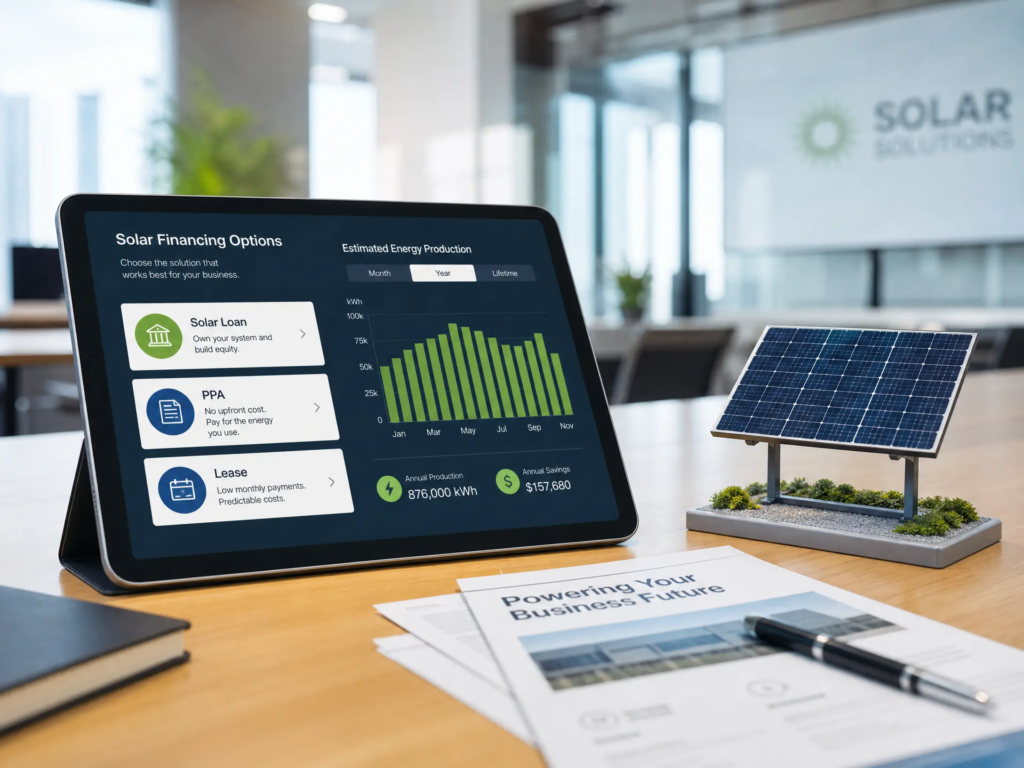
You don’t need to pay cash to go solar. South African businesses have four main financing routes in 2026:
- cash purchase, asset finance (a solar loan),
- an operating lease or rental, and
- a Power Purchase Agreement (PPA) with zero money down.
Each one trades off upfront cost against long-term value and, importantly, against who gets the Section 12B tax benefit.
The short version: if you can buy outright or qualify for asset finance, ownership almost always delivers the best long-term value because you keep the tax deduction and own the asset.
Zero-upfront options like PPAs and rentals make the most sense when preserving cash, outsourcing maintenance, or avoiding a capital outlay matters more than lowest total cost.
This guide walks through each option so you can pick the right one for your business.
This article is general information, not financial advice. The right structure depends on your cash position, tax situation and balance sheet — discuss it with your accountant or financial advisor before committing.
Do I have to pay cash for commercial solar?
No. While paying cash gives the best long-term return, most South African businesses today finance solar in a way that requires little or no upfront capital. The four main routes are:
- Cash / outright purchase — you own it, and get the full tax benefit.
- Asset finance (solar loan) — you borrow, own the asset, and repay monthly.
- Operating lease / rental — you rent the system for a fixed monthly fee.
- Power Purchase Agreement (PPA) — a provider owns the system; you just buy the power.
Let’s look at each.
Option 1: Cash or outright purchase
You fund the system from your own capital and own it from day one.
The upside:
This delivers the strongest long-term return of any option. You claim the full Section 12B deduction (100% of the cost in year one for a qualifying system up to 1 MW), you can reclaim the input VAT if you’re VAT-registered, and every rand of electricity saving flows straight to your bottom line.
There’s no interest, no lease fee, and the lowest total cost of ownership over the system’s 20-plus-year life.
The trade-off:
It ties up working capital.
For a system costing anywhere from R400,000 to several million rand, that’s a meaningful outlay, though the Section 12B deduction softens the blow considerably in year one.
Best for: Businesses with available reserves that want the maximum return and the full tax benefit.
Option 2: Asset finance (a solar loan)
Here a bank or lender advances the cost, and you repay it monthly over a fixed term, while owning the asset (or owning it outright at the end of the term).
Most major South African banks (FNB, Absa, Nedbank, Standard Bank and asset-finance arms like WesBank/MFC) offer solar or green-energy finance.
In early 2026, with prime sitting around 11.5%, commercial solar asset finance has typically been priced in the region of 13% to 16%, depending on your credit profile.
Development finance institutions such as the IDC offer concessional rates for larger qualifying projects.
The key advantage:
Because you own the asset (under an instalment-sale or hire-purchase structure), you still claim the Section 12B deduction, unlike a lease or PPA.
And here’s the clincher for cash flow: a well-sized system’s monthly electricity saving can often exceed the monthly finance repayment, meaning many businesses are cash-flow positive from month one, even while paying the loan off.
The trade-off:
You pay interest, so the total cost is higher than cash. Watch for initiation and monthly service fees on top of the repayment.
Best for: Businesses that want ownership and the tax benefit without the full upfront outlay. (Whether it works comes down to one question — see “the question that decides it” below.)
Option 3: Operating lease or rental
Under an operating lease, a finance company owns the system and you pay a fixed monthly fee to use it, typically over a set term.
The upside:
It preserves your working capital, gives predictable monthly costs, and the fixed fee doesn’t fluctuate with how much power the system produces.
The trade-off, and it’s an important one:
Because the finance company owns the asset, they claim the Section 12B allowance, not you. The total cost over the term is usually higher than buying or financing to own, and you’ll want to read the end-of-lease and residual-value terms carefully.
Best for: Businesses that prioritise preserving capital and predictable costs over owning the asset or claiming the tax benefit.
Option 4: Power Purchase Agreement (PPA)
A PPA is the only option that requires absolutely no upfront capital and no balance-sheet commitment.
A solar developer installs, owns, operates, maintains and insures a system on your premises at their cost and you simply buy the electricity it generates, usually at a rate 10% to 30% below your current grid tariff.
You save from day one without spending a cent on hardware.
A few things to understand about PPAs:
- Term: typically 10 to 20 years.
- Who gets the tax benefit: the provider owns the system, so they claim Section 12B — not you.
- Escalation: most PPAs include an annual tariff escalation, often around 5% to 8% — usually lower than Eskom’s historical increases, but you’re still on a rising rate.
- Structures: “take or pay” (you pay a fixed amount for all power the system produces) versus “no take, no pay” (you pay only for the power you actually use — effectively pay-as-you-go).
- Buyout: many PPAs let you buy the system at a residual value after a few years or at the end of the term.
- Requirements: because the provider needs long-term access to your roof, PPAs require security of tenure, they suit owner-occupied premises or long leases.
Best for: Businesses wanting zero upfront cost, immediate savings and fully outsourced maintenance and that expect to stay put for the long term.
What about rent-to-own?
Rent-to-own sits between renting and buying: you pay a fixed monthly amount, and ownership transfers to you after the final payment.
It’s usually the easiest option to qualify for… providers often run a lighter affordability check because they keep the equipment as security until it’s paid off.
The trade-off is that it typically carries the highest total cost of all the routes. It’s a practical entry point for businesses that can’t access bank finance or capital but still want to end up owning the system.
Which option is cheapest overall?
An honest answer matters here, because solar isn’t the right fit for every site. It may not pay off well if:
- Your business uses very little power during daylight hours. If you only operate at night, you’ll lean heavily on batteries, which lengthens the payback.
- You’re on a short lease with no buy-in from the landlord. Solar is a long-term asset best suited to premises you’ll occupy for years.
- Your roof is unsuitable heavily shaded, structurally weak, or too small — with no ground-mount alternative.
- Your electricity bill is already very low. If you’re spending a few thousand rand a month, the savings may not justify the capital outlay.
A proper energy audit will tell you honestly which camp you fall into — and a reputable installer will tell you if solar *isn’t* your best move.
How do I know if solar is right for my specific business?
Here’s how the routes compare at a glance:
Option
Upfront cost
Who owns the system
Who claims Section 12B
Relative total cost
Best for
Cash purchase
High
You (day one)
You
Lowest
Best return, full tax benefit
Asset finance (loan)
Low / none
You
You
Low–moderate
Ownership without the big outlay
Operating lease / rental
None
Financier
Financier
Higher
Preserving capital, fixed costs
PPA
None
Provider
Provider
Higher
Zero upfront, outsourced maintenance
Rent-to-own
Low / none
You (at end)
Varies
Highest
Easiest to qualify for
The pattern is clear: the less you pay upfront, the more you tend to pay overall — and the ownership routes (cash and asset finance) are the only ones where you keep the Section 12B tax benefit for yourself.
As a rule of thumb, if you can afford to buy or qualify for a solar loan, ownership is almost always the better long-term value.
Zero-upfront models earn their place when capital or credit is the barrier, or when you’d rather hand off all the maintenance and risk.
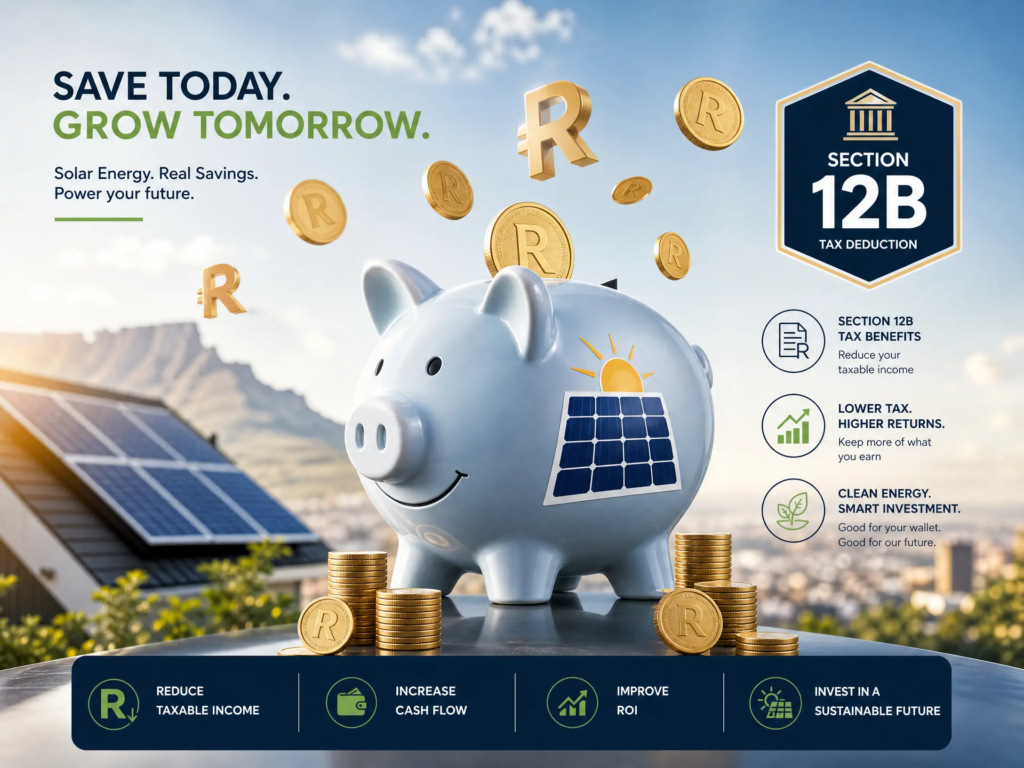
The tax angle: who actually gets Section 12B?
This is the detail that quietly changes the maths.
Section 12B goes to whoever owns the system.
- Cash purchase or asset finance (instalment sale/hire purchase): you own it, so you claim the 100% first-year deduction.
- Operating lease, rental or PPA: the financier or provider owns it, so they claim the deduction and typically factor that benefit into the rate they offer you.
That’s a big reason ownership tends to win on total value: the tax benefit stays with you. (For the full detail on how the deduction works, see our guide to the Section 12B solar tax deduction and always confirm your position with a registered tax practitioner.)
The question that decides it: does my saving beat my payment?
Whichever financed route you’re weighing, the single most useful test is simple:
Is my monthly electricity saving larger than my monthly finance payment (or PPA/lease fee)?
If yes, the system effectively pays for itself out of the money you’re already spending on electricity — and you’re better off from month one.
For a well-designed, correctly sized system on a business with solid daytime usage, the answer is often yes. But it isn’t guaranteed, so run the actual numbers for your site before signing anything.
(Our guide on solar payback and ROI shows how to work this out.)
What to watch out for
A few things worth scrutinising before you commit:
- PPA and lease fine print: the escalation rate, any minimum consumption commitment, termination/lock-in clauses, and the buyout formula. Have a lawyer review a PPA before signing — these are long, complex contracts.
- Total cost of ownership, not just the monthly figure: a low monthly fee can still add up to far more than owning over 20 years.
- Who’s responsible for maintenance and insurance, and what counts as fair wear-and-tear.
- What happens if you move or sell — leases and PPAs can complicate a property sale, so understand the transfer process.
How Allsolar helps you find the right fit
The best financing route only works with a system that’s correctly sized for your business… an oversized system inflates whatever you’re paying, and an undersized one leaves savings on the table.
That’s why we start with an energy audit to design around your actual usage.
Allsolar provides turnkey design, supply, installation and compliance, with the itemised documentation and Certificate of Compliance that asset finance and a Section 12B claim both depend on.
Our modular, expandable approach is also one of the most practical ways to manage upfront cost without borrowing at all, you can start with the system that covers your priority loads and scale up in stages as your budget allows.
With more than 30 branches across Southern Africa and roots in the industry since 2012, we’ll help you weigh the options and structure something that fits your cash flow.
Allsolar is not a financial advisor. For finance and tax decisions, please consult your accountant, financial advisor or a registered tax practitioner.
Frequently asked questions
Can I get commercial solar with no money down in South Africa? Yes. A Power Purchase Agreement (PPA) requires no upfront capital — a provider installs and owns the system, and you buy the power it generates at a rate usually 10% to 30% below your grid tariff. Rentals and some rent-to-own products also offer zero or low upfront cost.
What are the financing options for commercial solar? The four main routes are cash purchase, asset finance (a solar loan), an operating lease or rental, and a PPA. Cash and asset finance mean you own the system and keep the Section 12B tax benefit; leases and PPAs mean the provider owns it and claims the tax benefit.
Which solar financing option is cheapest? Buying outright has the lowest total cost of ownership and the full tax benefit, followed by asset finance. Leases, PPAs and rent-to-own require little or no upfront cash but cost more over the full term. Generally, the less you pay upfront, the more you pay overall.
Do I still get the Section 12B tax deduction if I finance the system? It depends on ownership. With a cash purchase or asset finance (instalment sale/hire purchase) you own the system and claim the deduction. With an operating lease or PPA, the financier or provider owns it and claims the deduction instead.
Will my solar savings cover the monthly finance payment? Often, yes. For a well-sized system on a business with good daytime electricity use, the monthly saving can exceed the monthly repayment, making you cash-flow positive from the start. It isn’t guaranteed, so model the numbers for your specific site first.
What should I check before signing a solar PPA? Scrutinise the annual escalation rate (commonly 5% to 8%), any minimum consumption commitment, termination and lock-in clauses, the buyout formula, and what happens if you sell the property. Have a lawyer review the agreement before signing.
Want help choosing the right way to fund your solar?
There’s no single best financing option… only the one that fits your business’s cash flow, tax position and plans. The starting point is a correctly sized system and a clear view of the numbers.
Allsolar provides energy audits and turnkey commercial solar solutions, with the compliant documentation your finance and tax claims rely on, backed by a nationwide network of more than 30 branches.
To explore the options and get a solution structured around your budget, contact your nearest Allsolar branch or request a quotation.
The figures in this guide are realistic 2026 averages, but the only way to know what solar is worth for your business is to look at your actual energy use, roof and tariff.
Allsolar offers energy audits and turnkey commercial solar solutions, from professional system design and supply through to installation, integration and ongoing maintenance, backed by a nationwide network of more than 30 branches.
If you’d like an indication of costs and savings tailored to your premises, contact your nearest Allsolar branch and request a quotation.
There’s no obligation, just clear, honest information to help you make the right call.
This article is general information reflecting the South African solar finance market as of mid-2026. Rates, products and tax rules change over time, and the right choice depends on your circumstances. Allsolar is not a financial advisor or tax practitioner, please consult the appropriate professional before making financing decisions.